
You open your tax results and look at the screen again. Last year you got a larger refund. This year you worked similarly, earned almost the same, and you don't understand what happened. Then a friend comments: “I got a pretty big refund.” And the doubts begin.
Before comparing refunds, it is worth comparing the pieces of the return. Two people with similar salaries can end up with different results. Here we will separate those pieces, without turning your kitchen table into an accounting class.
The refund starts long before filing
When your employer withholds federal income tax, they advance part of that tax during the year. The amount depends on what you earn and the information you provided on your W-4. That form helps calculate the withholding; the W-2 summarizes at the end of the year what you earned and what was withheld. IRS · Tax Withholding (opens in a new tab)
When filing the return, the total tax is compared against the payments that count in your favor. If the payments are higher, there may be a refund; if they are lower, there may be a balance due. Therefore, looking only at how much you were refunded does not explain how much tax you actually owed. IRS · How a refund or balance is determined (PDF, in English) (opens in a new tab)
Additionally, there are refundable credits: if you meet their requirements, they can generate a refund even when you do not owe tax. Do not assume that you and your friend qualify for the same things. Eligibility is reviewed based on each person's actual situation. IRS · Refundable credits (in English) (opens in a new tab)
Same tax, two different outcomes
Imagine these two fictional cases. In both, the final federal tax is $4,200. To keep the comparison simple, we have excluded other payments, credits, and adjustments. We only change how much was paid in advance through withholdings.
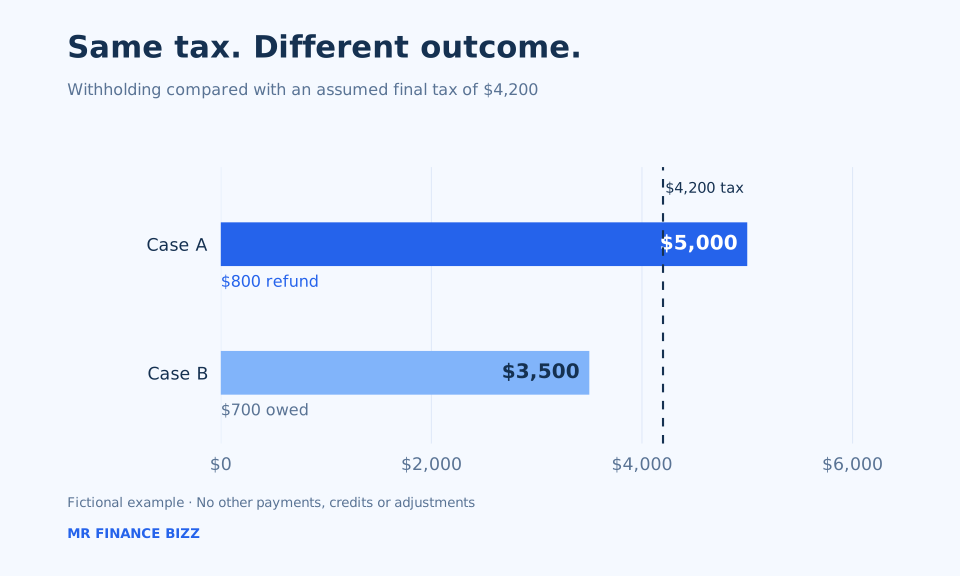
View chart numbers
| Item | Case A | Case B |
|---|---|---|
| Withholdings | $5,000 | $3,500 |
| Assumed final tax | $4,200 | $4,200 |
| Result | $800 refund | $700 balance due |
Case A paid $800 more than the final tax; Case B paid $700 less. Neither result, on its own, proves that one return was prepared better. The useful question is: “Were my income, payments and the benefits I qualify for reported correctly?”
W-2 boxes you should recognize
| Box | What it shows |
|---|---|
| 1 | Wages, tips, and other compensation reported for federal income tax. |
| 2 | Federal income tax withheld. |
| 4 and 6 | Social Security and Medicare withholdings, respectively; these are distinct from Box 2. |
These names come from the IRS form itself. Do not add up all withholdings as if they were advances on the same tax. And if you find an incorrect name, salary, or amount, contact the employer to see if a corrected W-2 should be issued. IRS · Form W-2 and instructions, 2026 (PDF) (opens in a new tab)
Living in Florida does not eliminate federal taxes
Florida does not charge a state personal income tax and does not require a personal return for that tax. That does not eliminate federal obligations. If you worked or lived in another state as well, let us know when preparing your return so that case can be reviewed separately. Florida Department of Revenue · State personal income tax (in English) (opens in a new tab)
During a consultation, “I worked a few months outside Florida” can be more useful than a folder full of papers with no explanation. Make a short list of changes during the year: jobs, moves, marriage, separation or family changes. You will not have to remember everything on the spot.
What you can review before your next paycheck
The IRS withholding estimator allows you to review withholding for W-2 jobs and certain pensions and prepare a W-4 adjustment. Have recent pay stubs and your previous return on hand; if filing jointly, also have your spouse's information. It is advisable to review this when changing jobs or family status. The tool is not designed for nonresident alien taxpayers for tax purposes. IRS · Tax Withholding Estimator (opens in a new tab)
- Gather the W-2s from all your jobs; a return is reviewed with the complete picture.
- Write down what outcome you expected and why. Ask them to explain the difference between tax, withholdings, and refund.
- If you decide to change your withholding, submit the updated W-4 to your employer and check the next pay stubs.
You can start with our W-2 calculator for basic guidance. The result is a simplified federal estimate: it does not include all credits nor does it replace reviewing your complete return.
Open the W-2 calculatorWhat you might still be wondering
Does a small refund mean I did my taxes wrong?
Not necessarily. The example shows how the same tax can result in a refund or a balance due depending on the advances. To evaluate your return, the complete data must be reviewed.
Is Box 2 of the W-2 all I get back?
No. It is the federal income tax withholding. The return outcome also depends on the total tax, other payments, and the applicable credits.
Can I use this example to calculate my own return?
No: the amounts are fictional. They serve to understand the relationship between withholdings and tax, not to calculate an individual return.
Sources and review
We consulted these official sources on September 5, 2026. The examples and charts are created by MrFinanceBizz; they do not show client data.
- IRS · Tax Withholding (opens in a new tab)
- IRS · How a refund or balance is determined (PDF, in English) (opens in a new tab)
- IRS · Refundable credits (in English) (opens in a new tab)
- IRS · Form W-2 and instructions, 2026 (PDF) (opens in a new tab)
- Florida Department of Revenue · State personal income tax (in English) (opens in a new tab)
- IRS · Tax Withholding Estimator (opens in a new tab)
General educational information. Rules and your situation may change; before making a tax or financial decision, review your case and the rules for the corresponding year.
Understand your taxes before you file.
Personal tax preparation: $120 for new clients; regular price $150. Tell us your situation and we will review the next step with you.
Chat on WhatsApp
