
You finished the job, the client paid, and you see the deposit in your account. It feels good. But between materials, gas, tools, and household expenses, that money starts to disappear. When tax season arrives, you have to reconstruct twelve months of memory.
If you do cleaning, repairs, deliveries, design, or other services on your own, you need a way to know what part of what you charge belongs to the business. You can start with a small routine, even if you do not yet have a team or an office.
The 1099 is a document; your records tell the complete story
You must report taxable income from your activity even if you do not receive a Form 1099. Do not use the arrival of a paper as the criterion for deciding which payments to record. IRS Publication 334 explains this obligation for small businesses. IRS · Publication 334, guide for small businesses, 2025 edition (in English) (opens in a new tab)
A practical starting point: list each job, its date, the client, the amount collected and how they paid. When a tax form arrives, you can compare it with your records instead of guessing what it includes. Flag any differences to review before filing.
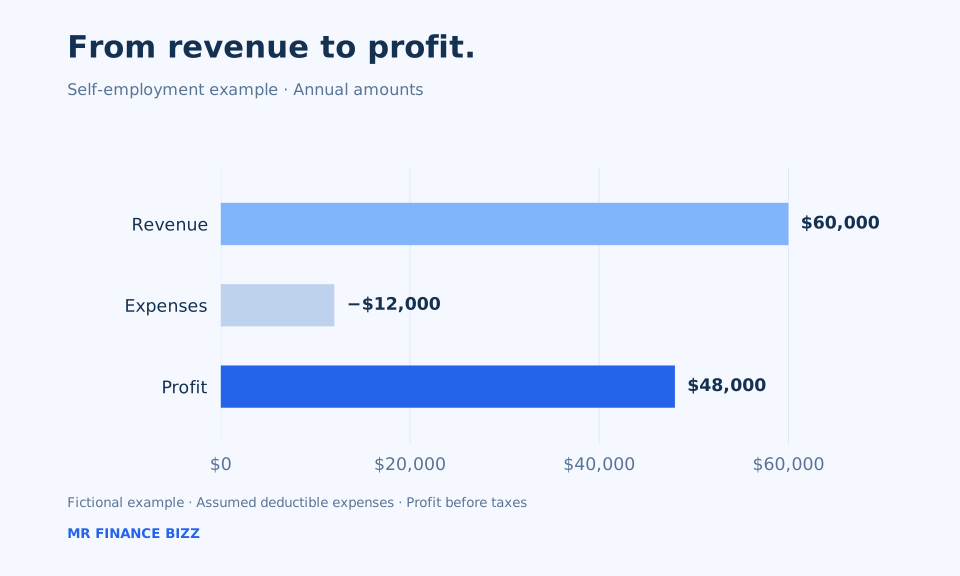
Collecting $60,000 does not mean $60,000 in profit
For a self-employed activity, net profit is obtained by subtracting business expenses from income. Generally, the independent worker must consider both income tax and self-employment tax. This guide uses an individual activity as an example; if you have a company, first review how it is taxed. IRS · Tax Center for self-employed workers (in English) (opens in a new tab)
View chart numbers
| Item | Annual amount |
|---|---|
| Business income | $60,000 |
| Business expenses | −$12,000 |
| Pre-tax profit | $48,000 |
The $48,000 is a starting point, not a promise of available money. This example does not calculate your taxes nor include owner withdrawals, loans, or differences between when money is collected and when it is paid. Its utility is simpler: it forces you to separate what you sold from what it cost to produce it.
An expense needs an explanation, in addition to a charge on the card
Generally, a deductible business expense must be ordinary and necessary for that activity. A personal expense does not become a deduction just because it was paid with a business card. When an expense mixes personal and commercial use, it is necessary to review what part corresponds and what rules apply. IRS · Publication 334, guide for small businesses, 2025 edition (in English) (opens in a new tab)
The IRS allows choosing a recordkeeping system suitable for the business that clearly shows income and expenses. It also requires the ability to substantiate what is reported. Keeping receipts and relating them to each transaction makes it easier to explain a deduction; a list of amounts without context leaves work pending. IRS · Business records and receipts (in English) (opens in a new tab)
- Keep the invoice or receipt and note for which job or activity it was used.
- Separate personal transactions and mark transfers, contributions, or loans to classify them correctly.
- Do not delete a transaction you do not understand: mark it as pending and look for the receipt.
- At month-end, compare your records with the statement and resolve any discrepancies.
For example: “Store purchase, $180” says little. “Materials for Tuesday’s client repair, receipt saved” gives you a concrete clue to review. The habit matters more than having an app full of categories that no one has confirmed.
Do I need to set aside money for estimated tax payments?
The answer depends on your complete projection. General IRS rules consider whether you expect to owe at least $1,000 after withholding and refundable credits, and whether your payments reach certain levels of the current or prior year’s tax. Conditions and exceptions apply: the $1,000 threshold alone does not determine whether you need to make estimated payments. IRS · Questions about estimated taxes (in English) (opens in a new tab)
Before choosing an amount to set aside, request a review that accounts for your expected profit, other income, withholdings, and prior return. Note how much you propose to reserve, how it was calculated, and when it will be reviewed again. This allows you to update the plan if you sell much more in a month or lose an important client.
If you prefer working with envelopes or separate accounts, label the money reserved for taxes. Keeping it visible can help you avoid confusing it with funds available for your personal expenses. There is no single percentage that this article can recommend for all businesses.
Twenty minutes a week with your numbers
Try this routine on the same day each week. Set a timer, open your transactions and start with the oldest one you haven't reviewed. You don't have to sort out the whole year in one sitting.
- First 5 minutes: record what was collected and what is still outstanding.
- Next 10 minutes: save receipts and review pending transactions.
- Last 5 minutes: note questions for your accountant and check upcoming payments.
At the end of the month, you should be able to answer three questions with your records in front of you: how much you collected, how much you spent on the business, and what remains to be clarified. If you cannot, that is the point to organize before discussing how to save on taxes.
Do you also receive a W-2? Read how the refund worksWhat you might still be wondering
Can I leave out payments if I didn't receive a 1099?
No. Taxable income from your activity is reported even if you do not receive that form. Review your records, not just the documents sent to you.
Is everything I pay with the business account deductible?
No. The purpose of the expense, applicable rules, and documentation determine its treatment. Personal expenses do not become deductible by changing cards.
Are the $48,000 in the example what I can take home?
No. That is the assumed profit before taxes. Available funds also require reviewing obligations, cash, and business needs.
Sources and review
We consulted these official sources on September 5, 2026. The examples and charts are created by MrFinanceBizz; they do not show client data.
- IRS · Publication 334, guide for small businesses, 2025 edition (in English) (opens in a new tab)
- IRS · Tax Center for self-employed workers (in English) (opens in a new tab)
- IRS · Business records and receipts (in English) (opens in a new tab)
- IRS · Questions about estimated taxes (in English) (opens in a new tab)
General educational information. Rules and your situation may change; before making a tax or financial decision, review your case and the rules for the corresponding year.
Let every dollar have an explanation.
Bookkeeping from $250 per month for up to 100 transactions; $350 for 101 to 200. Includes reconciliation and reports. For more than 200, we will prepare a quote.
Chat on WhatsApp
