
The car starts making a strange noise right after you pay rent. It was not in the plan. And if you rely on the car to work, putting it off until next month does not seem like an option either. Having something saved does not fix the breakdown, but it can give you room to decide how to resolve it.
If your income changes every week, you may have tried saving a fixed amount and abandoned it at the first difficult month. Let’s set a goal you can adjust. We will use $1,000 as a first example step, not as a sufficient amount for all families.
Give that money a specific job
An emergency fund is a reserve for unexpected expenses or a drop in income. The right amount depends on your situation. Even a small reserve can help; the CFPB recommends that the money be safe, accessible, and separate from daily spending temptations. CFPB · Guide to creating an emergency fund (in English) (opens in a new tab)
Write a phrase you can use to decide: “This money helps me when an unexpected necessary expense comes up.” Then think about three situations from your life, not someone else’s: an urgent repair, an unexpected medical bill, or several days without being able to work.
It is also helpful to distinguish an unexpected event from an expense you already know about. If you know you will renew an insurance policy in three months, you can prepare for it in a separate category. Naming each goal prevents the same savings from appearing available for five things at once.
Three paths to reach the first step
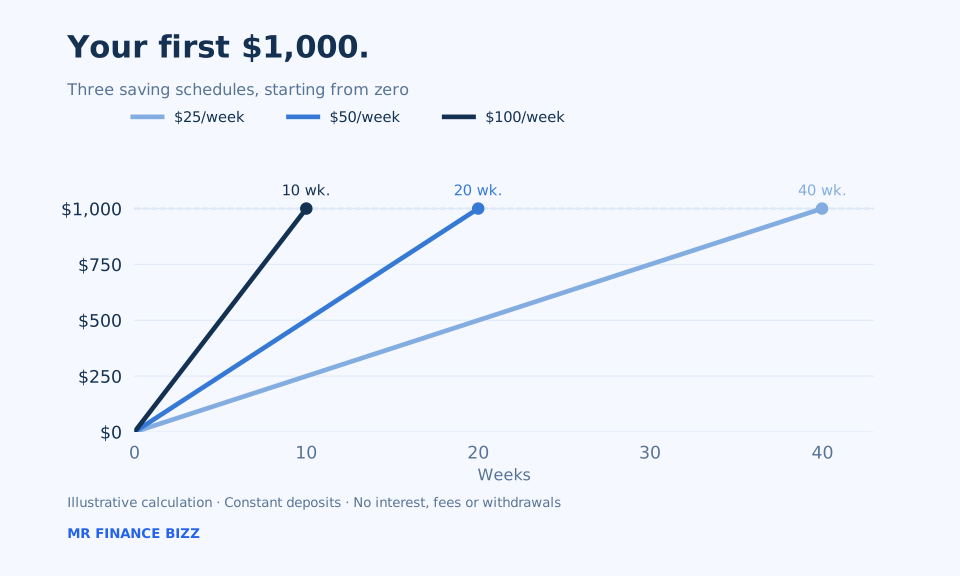
There is no investment strategy or rate of return here. We simply add weekly contributions until reaching $1,000. The chart assumes you start from zero, do not withdraw money, and maintain each contribution.
View chart numbers
| Savings per week | Time to $1,000 |
|---|---|
| $25 | 40 weeks |
| $50 | 20 weeks |
| $100 | 10 weeks |
If $100 per week does not fit your budget, that line is not an obligation. Choose a figure you can test and review it when your income changes. If you cannot contribute one week, the goal shifts; you do not need to start counting from zero.
How much time do you need?
Try a goal and a weekly contribution. No registration required.
Illustrative calculation with constant contributions. Rounds to complete weeks; does not include interest, fees, or withdrawals. Amounts are calculated in your browser and are not saved.
Make the plan with the money that actually comes in
The CFPB suggests tracking income, expenses, and due dates to build a realistic budget. Sometimes the problem is timing: bills come due before you get paid. Looking at one week at a time can help detect that mismatch. CFPB · How to create a budget (in English) (opens in a new tab)
Try this exercise: on a sheet of paper, write how much came in this week. Below that, list what you must pay before your next paycheck and leave a line for less frequent expenses. The savings you plan must coexist with those needs.
If your numbers leave no margin, do not fudge them to make savings appear. Start by identifying which payment or timing issue is putting you under pressure. A plan that requires leaving a basic need uncovered does not become viable just because it looks good on paper.
If your income is irregular, you can use a better week to make an additional contribution. If you automate transfers, first check the dates and available balance to avoid overdraft fees. The CFPB highlights both precautions when explaining how to build the habit of saving. CFPB · Guide to creating an emergency fund (in English) (opens in a new tab)
Where to keep it so you can use it when needed
When comparing accounts, look at fees, balance requirements, and how you would withdraw the money in an emergency. Seek clear information about the institution and the product. An account that seems convenient may not work for you if accessing the money is costly or complicated.
At an FDIC-insured bank, standard deposit insurance coverage is $250,000 per depositor, per insured bank, and per ownership category. It does not mean $250,000 independent coverage for each account you open at the same bank. Verify that the institution is insured and how coverage applies to your deposits. FDIC · How deposit insurance works (opens in a new tab)
For money you might need soon, the risk of having to sell at a loss matters. Investor.gov warns that risky investments may be unsuitable for short-term goals. Do not confuse your emergency reserve with money you decide to invest for the long term. Investor.gov · Risk and savings horizon (in English) (opens in a new tab)
Using it for an emergency is part of the plan
Imagine you saved $600 and need $200 for a real emergency. You have $400 left. The fund did exactly what it was there for. Note what happened, adjust your next deposit and keep going from your current balance.
When you reach the first step, ask another question: “What necessary expense would still leave me without a margin?” Your next goal may be different if you change jobs, your family grows, or you rely on a strong season to cover slower months. The amount must reflect your life.
If you are self-employed, keep your personal savings separate from what you set aside for taxes or business expenses. One amount cannot cover all three obligations at the same time.
Organize the income and expenses of my self-employmentWhat you might still be wondering
Do I have to start with $1,000?
No. It is an illustrative goal. You can start with a smaller amount and increase it based on your expenses, obligations, and income stability.
What happens if I cannot save one week?
Update the timeframe with your actual balance and a contribution you can sustain. The calculator assumes constant contributions; if they change, the time changes too.
Does the calculator include interest?
No. It only divides what is left to reach your goal by the weekly contribution and rounds up. It does not include returns, fees, or withdrawals.
Sources and review
We consulted these official sources on September 5, 2026. The examples and charts are created by MrFinanceBizz; they do not show client data.
- CFPB · Guide to creating an emergency fund (in English) (opens in a new tab)
- CFPB · How to create a budget (in English) (opens in a new tab)
- FDIC · How deposit insurance works (opens in a new tab)
- Investor.gov · Risk and savings horizon (in English) (opens in a new tab)
General educational information. Rules and your situation may change; before making a tax or financial decision, review your case and the rules for the corresponding year.
A next step with your finances.
We serve families and businesses across South Florida in English and Spanish. Explore our tax and bookkeeping services and the tools available to our clients.
Chat on WhatsApp
